Artikel: Scaling for Security: How Defense Manufacturers Can Accelerate Production Ramp-Up
Europe’s rising defense demand is putting industrial capacity under pressure. Manufacturers can accelerate production ramp-up by unlocking existing capacity, industrializing production and suppliers, and building scalable, resilient production networks.
The European defense industry is at a turning point. A fundamentally changed security environment has brought defense readiness back to the center of political and economic agendas. What was long characterized by comparatively stable demand and lengthy planning cycles is giving way to an environment that requires greater speed, flexibility and industrial responsiveness. The ability to translate strategic ambitions into tangible industrial output is becoming a defining challenge for the sector.
Rising Defense Demand Is Putting Industrial Capacity Under Pressure
Europe’s changing security environment is translating into structurally higher defense demand. EU Member States spent €418 billion on defense in 2025, around 20% more than in 2024, with expenditure projected to reach €454 billion in 2026. At the same time, NATO’s new Defense Investment Pledge reinforces the long-term nature of this development, with Allies committed to investing 5% of GDP annually in defense and security-related expenditure. For manufacturers, this creates substantial growth opportunities but also raises expectations regarding the speed and scale at which capacity can respond. The decisive question is therefore shifting from whether demand will materialize to whether industrial output can keep pace with it.
Orders Do Not Automatically Translate into Output
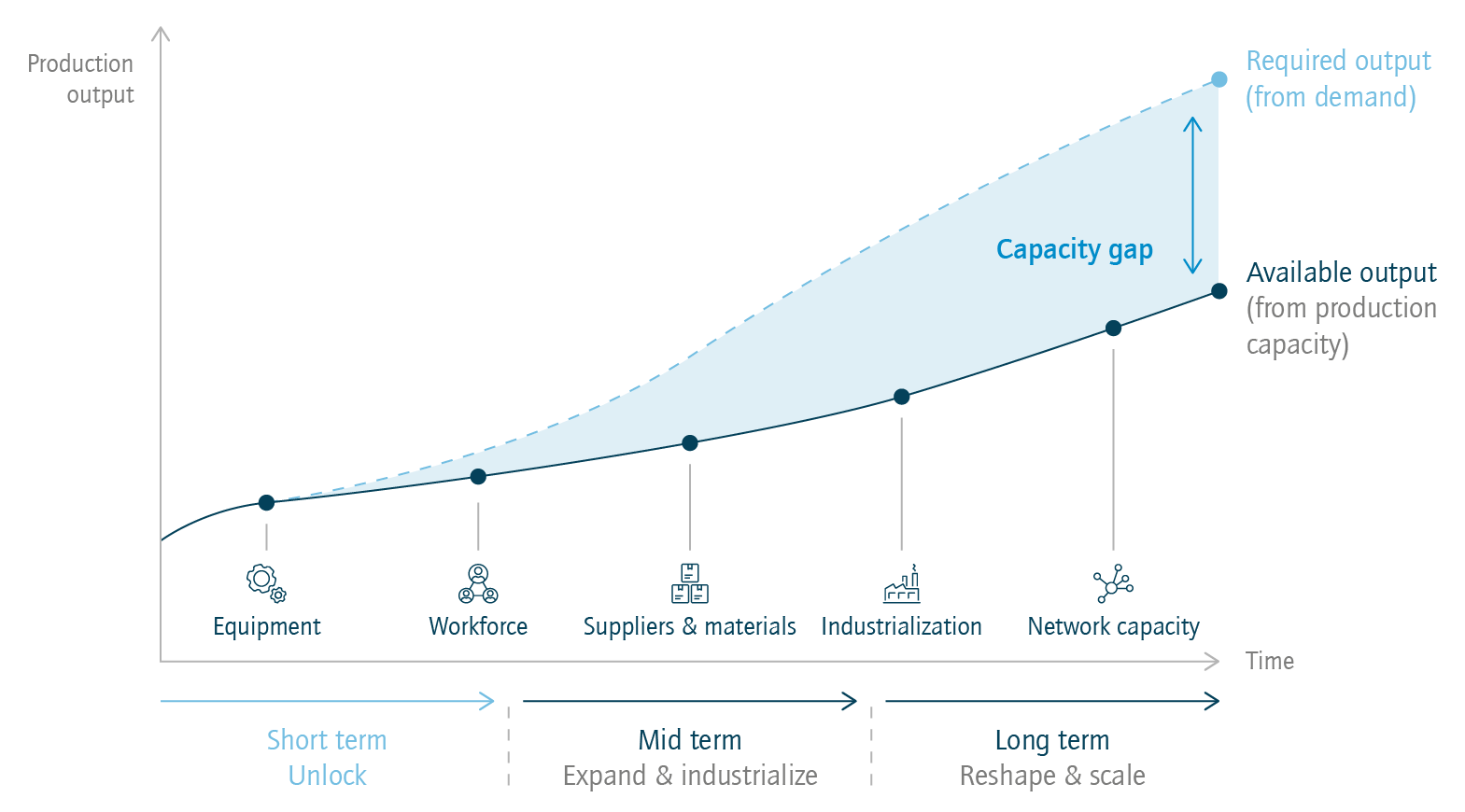
The rapid increase in defense demand is colliding with an industrial system that cannot scale at the same speed as order intake. Defense output depends on the synchronized availability of specialized equipment, skilled workforce, materials, supplier capacity and sufficiently industrialized production processes. As volumes increase, however, these constraints do not remain static: resolving one bottleneck can expose the next, causing the limiting factor to shift across the value chain throughout the ramp-up. The resulting gap between required and available output therefore cannot be closed through a single capacity measure. Instead, manufacturers need to address different constraints at different stages of the ramp-up, moving from unlocking existing assets and workforce in the short term, to scaling and industrializing production and suppliers in the mid-term, and ultimately creating a flexible and resilient production network. The following ramp-up logic illustrates how these shifting bottlenecks shape the path from rising demand to sustainable production capacity.
Unlock Capacity Within the Existing Footprint
The fastest additional capacity is often capacity that already exists but is not fully productive. Defense manufacturers should therefore first establish where actual throughput is constrained and distinguish theoretical capacity from capacity that can reliably deliver at the required quality and schedule. A fact-based assessment of equipment, workforce, and production flows can reveal significant headroom without adding new production lines. Rather than maximizing utilization across every asset, improvement efforts should focus on the constraints that determine system output:
Remove critical bottlenecks through targeted OEE, cycle-time, and changeover improvements
Increase asset availability through optimized maintenance and reduced unplanned downtime
Extend productive capacity through shift adjustments and workforce reallocation
Synchronize planning and execution to stabilize material flows and increase throughput
These measures can unlock capacity comparatively quickly while larger investments are being prepared. Once economically accessible reserves are exhausted, however, sustained growth requires structural expansion and industrialization.
Expand and Industrialize the Production System
Structural expansion should not simply replicate today's production system at a larger scale. Higher volumes create an opportunity to rethink how products and processes are industrialized and to build a system in which output can grow without cost and complexity rising proportionally. At the same time, capacity expansion must extend beyond the OEM, as additional final assembly capacity creates little value if critical components remain constrained upstream. Key actions include:
Expand physical capacity through brownfield extensions, additional lines, and targeted equipment investments
Design production for scale through process standardization, complexity reduction, and automation
Scale critical suppliers in parallel through demand transparency, supplier development, and capacity commitments
Reassess sourcing and make-or-buy where external dependencies constrain future output
The objective is therefore not simply to install more capacity, but to industrialize the entire value chain for higher and more predictable volumes.
Build a Scalable and Resilient Production Network
As higher demand becomes structural, the perspective needs to broaden from individual factories to the architecture of the overall production network. Future footprint decisions should balance economies of scale with geopolitical exposure, access to suppliers and skills, technological sovereignty, and continuity of supply. Instead of optimizing the network around one demand forecast, manufacturers need a configuration capable of responding to different future scenarios. This requires several strategic choices:
Redesign the production footprint around future demand, strategic capabilities, and geopolitical exposure
Localize critical capabilities where dependencies create unacceptable supply risks
Build flexibility into the network through modular capacity and predefined expansion options
Create targeted redundancy where security of supply outweighs pure cost efficiency
The target is therefore not simply a larger production network, but one that combines economic efficiency with the ability to absorb demand changes and maintain output under changing conditions.
From Capacity Expansion to Sustainable Defense Readiness
Sustainable defense readiness ultimately requires more than additional installed capacity. The target state is an industrial system that continuously connects evolving demand with capacity decisions and translates requirements into reliable output at the required speed, quality, and cost. Reaching this state requires the different time horizons to be managed as one integrated ramp-up agenda: operational excellence creates immediate headroom, industrialization enables economically viable scale, and strategic network design provides long-term adaptability. These activities cannot be addressed sequentially, since new industrial capacity can take substantially longer to establish than demand takes to emerge. Looking ahead, this ability to adapt may become as important as absolute production volume itself. Technologies, threat environments, and procurement priorities will continue to evolve, and the next capacity challenge may look different from today's. Defense manufacturers that embed scalability and resilience into their production systems now will therefore be better positioned not only to master the current ramp-up, but to respond to future requirements before the next capacity gap emerges.