Article : Agentic AI in Supply Chain Planning: Enhancing planning quality and decision speed
Visibility alone is no longer enough


Visibility alone is no longer enough
Supply chain planning has made significant progress in recent years: integrated planning systems, established monthly S&OP cycles, and a single set of numbers. Organizations now have visibility into underlying demand, capacity, and inventory trends. The challenge lies elsewhere. Organizations make decisions at the pace of their meeting calendars, while supply chains move at the pace of disruptions, and disruption has become the norm.
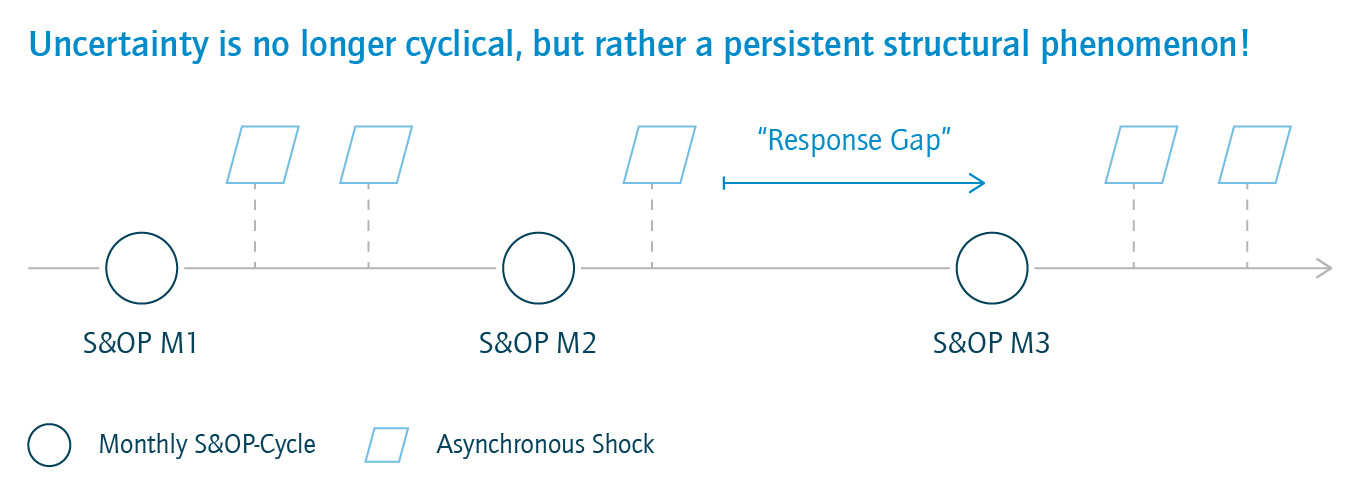
Many S&OP processes follow a familiar pattern. The core team spends the month preparing data, validating planning figures and analyzing bottlenecks, only for the executive meeting to acknowledge what has already happened. A decision-making forum becomes an information-sharing session. Competitive advantage in the years ahead will therefore depend not simply on better data, but on lower decision latency i.e., the time between a disruption and a decision.
This is where AI agents come in, although not in the way some boardroom presentations suggest. Agents do not make executive decisions. They shorten the time required to make an issue decision-ready: detecting deviations, simulating impacts, assessing alternatives, and preparing options for approval. They do so when supply chain disruptions occur, not when the planning calendar dictates.
By the early 2030s, AI agents will independently handle the initial response to a large proportion of disruptions without active human intervention. The extent of this automation will depend largely on supply chain maturity and the business model. Progress will be slower in traditional make-to-order environments with a significant project component than in highly integrated consumer goods supply chains.
Nevertheless, the direction of the COO agenda is clear: AI-driven efficiency gains in planning will be a top priority for supply chain leaders in the coming years.
Focusing solely on automation, however, is too narrow. Agents create value when they deliver three capabilities: recommending options with quantified financial implications, clearly explaining trade-offs and root causes, and progressively taking on autonomous planning and control as trust develops.
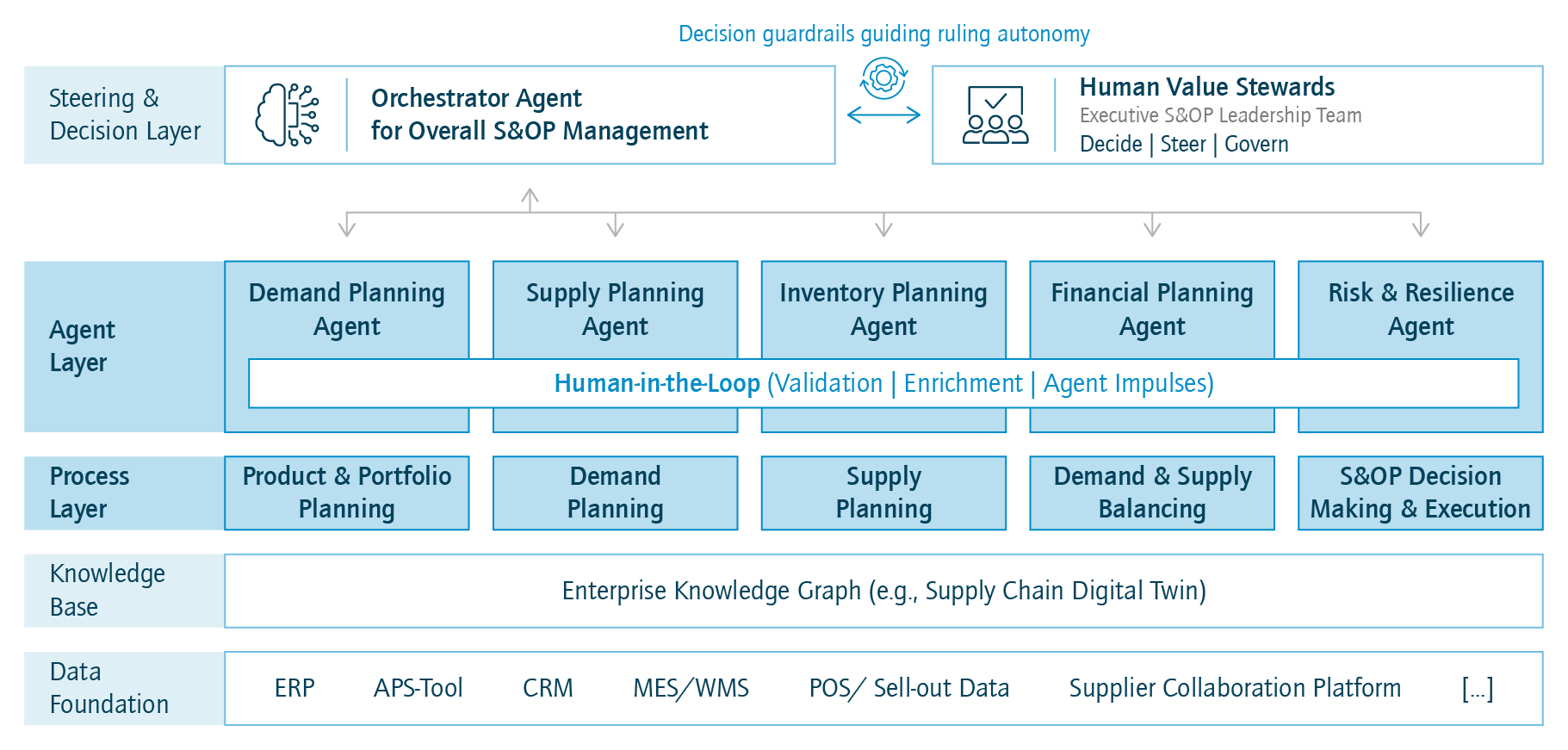
At the heart of this development is a multi-agent network in which specialized agents execute individual planning steps. An orchestrator agent, effectively a digital S&OP manager, coordinates their activities. It understands the business context and governance framework, activates the appropriate agents for each situation, continuously monitors KPIs, and prepares decision proposals for the executive S&OP meeting. An integrated data model, a digital twin of the supply chain, provides the foundation.
One principle is paramount: people remain accountable for value creation. This principle translates into two key design principles:
The top management participating in the executive S&OP meeting retain ultimate accountability for approving the jointly endorsed consensus plan.
A clear human-in-the-loop principle governs collaboration between planners and agents throughout the process.
To support this, the process defines handover points at which demand or supply planners review scenarios, approve their respective plans, and add context not captured in the data model.
This process perspective implies a fundamental shift in the planner’s role: rather than creating plans themselves, planners design the system that plans, and remain accountable for it.
This shift in roles reshapes the operating model and creates new requirements for processes, roles, governance, and management.
Companies must define the degree of autonomy agents are granted at each process step and where a planner must take over. Establishing fit-for-purpose decision-making principles is a prerequisite for effective control and organizational acceptance.
Planners must evolve from data processors into coordinators who steer scenarios and fine-tune agents.
Performance management must evolve accordingly. Continuing to measure activity rewards precisely the tasks agents will take over. The focus must shift to decision quality and system performance.
Without a robust operating model for human–AI collaboration, agentic automation, let alone autonomy, remains a future stage of development. The constraint is not today’s technological capabilities, but the maturity of processes, the organization, and data.
Companies that address these fundamentals create a solid foundation for their planning organization and position themselves to launch promising AI use-case pilots.
Tödt, S.
