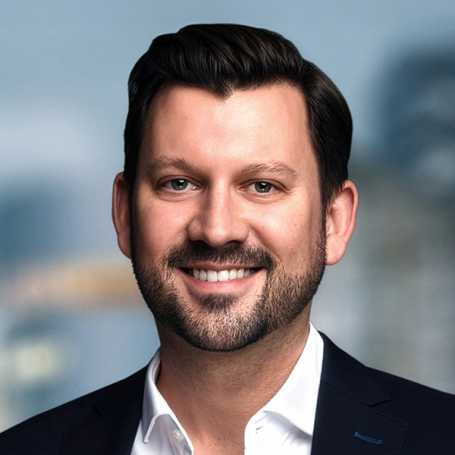
As Chief Transformation Officer (CTO), Dr. Pascal Engel is driving the digital transformation of facility management specialist Apleona GmbH. In this interview, he discusses how artificial intelligence can make processes more reliable and why the decisive point in transformation begins not with technology, but with the way people work. With a modern digital infrastructure, standardized data structures, and its own Agent Factory, Apleona has already laid important foundations. The focus now is on embedding AI into everyday work and harnessing its potential to improve service quality, efficiency, and management steering.
As Chief Transformation Officer, you are guiding Apleona through changes. Which development in AI do you believe will have the greatest impact on the facility management industry? :
ENGEL / Those who succeed in integrating AI into their core processes will be able to achieve a new level of service quality and reliability. This means that companies with the necessary foundations in place will not only be able to use AI agents or assistants to better support individual tasks, but also to have them take over entire workflows consisting of transactional activities. In a service business where the human element will always remain essential, this will allow us to achieve an entirely new level of quality, speed, and reliability.
Against this backdrop, where would you like to see Apleona in terms of AI adoption? :
ENGEL / Figuratively speaking, we want our AI-based processes to achieve the quality and reliability of a Swiss watch. This means reducing human error, minimizing deviations from standards, and thereby ensuring smooth building operations. We have laid the foundation for this over the past few years: We have invested significantly in our digital infrastructure, with state-of-the-art, scalable ERP and CAFM systems based on SAP S/4HANA and Planon, and established standardized data structures using Apleona’s proprietary AIM (Asset Information Modelling) data model. In addition, we are currently building the Apleona Agent Factory, which will enable us to develop new AI-powered agents and applications and enhance our existing systems going forward.
Where is AI already delivering tangible improvements in quality, productivity, or service delivery at Apleona? :
ENGEL / That applies to many areas. It started with Apleona Intelligence, our central, secure AI platform that provides features such as a chat function, systematic analysis of our own documents, and specialized agents. This gives all employees access to AI for everyday tasks. For example, information from lengthy contracts can be extracted and structured within seconds, invoices can be checked against quotes, deliveries, and contracts for consistency, and proposals and checklists can be created based on specific sources.
Beyond these general tasks, we also use AI selectively in specific functions. A few examples illustrate this: In IT, AI is already supporting software development; in HR, it conducts short interviews; and in Finance, it analyzes our corporate data, among other things, to generate new insights for decision-making. Another example is our 24/7 training assistant, which supports employees in using our ERP and CAFM systems, much like having their own key user.
What is required for the widespread adoption of AI? Which elements do you believe are often underestimated? :
ENGEL / Developing AI agents is challenging, but comparatively manageable. The greater challenge is sustainably changing behaviors and the organization itself. Even with a technology as powerful as AI, it is therefore essential to enable our employees to make new systems and tools an integral part of their everyday work.
The same applies to data quality: Establishing a solid data foundation once is not enough. Data changes continuously in day-to-day operations, which is why data maintenance must be embedded as an ongoing part of everyday work.
Both require an organization that is ready to take this step into the future and employees who are given comprehensive support and training along the way, whether it is about changing ways of working or continuously maintaining data. If either of these prerequisites is not met, the introduction of new technologies can ultimately fail as a result.
Apleona employs people in a wide range of roles, from building technicians to management. How do you ensure that the use of AI across such a diverse organization is consistently focused on creating value? :
ENGEL / For us, value does not come in just one form. It can manifest itself in different ways, for example through higher service quality, a more efficient cost structure, or more effective decision-making. Our main focus is our value creation process, because this is where we can always create direct value for our customers by improving operational service delivery.
Beyond the value creation process, we have made standard AI tools available across our workforce through Apleona Intelligence. Employees can use these tools individually to make their day-to-day work easier and create tangible value in their own tasks.
To address the specific requirements of our central functions, the individual units are also developing their own AI roadmaps. Selected use cases include eliminating repetitive administrative tasks in HR, automating ticket processing in IT, and providing an assistant to help prepare for procurement negotiations. All elements of these function-specific roadmaps are assessed against clear value criteria, with our central AI team reviewing and supporting the process.
About Pascal Engel
Dr. Pascal Engel is Chief Transformation Officer and a member of the Executive Board of Apleona GmbH, one of Europe’s leading facility management service providers, with 40,000 employees in more than 30 countries. He joined the company in 2019 and is responsible for its transformation and professionalization. His areas of responsibility include IT, AI & Data Analytics, Operational Efficiency, Digital Customer Solutions, and Green Real Estate.
Before joining Apleona, he worked at Boston Consulting Group in Munich and Frankfurt from 2008 to 2019, advising clients primarily on digitalization strategy and operations optimization. He holds a Ph.D. from WHU – Otto Beisheim School of Management in Vallendar and studied business administration at the University of Mannheim and the University of Florida in Gainesville, USA.
Expert article by Matthias Emler : Why More AI Does Not Automatically Create More Value
To the expert article
Interview with Kenza Ait Si Abbou Lyadini, AI Best-Selling Author : "AI Can Make Recommendations – Humans Must Make the Final Judgment"
To the interview